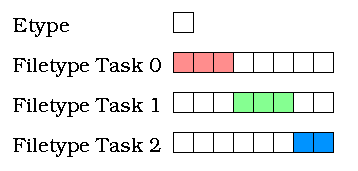
etype:
- basic unit of data access and file positioning
- can be any predefined MPI datatyp
-
derived datatypes possible, if:
- typemap displacements non-decreasing
- no negative displacements
filetype:
- sequence of etypes, possibly with holes in etype size

positioning:
- individual file pointer for each task (e.g. MPI_File_read)
- one file pointer common to all tasks (e.g. MPI_File_read_shared) (requires same file view for all tasks)
- explicit offset (e.g. MPI_File_read_at)
synchronism:
- blocking (e.g. MPI_File_read)
- non-blocking (e.g. MPI_File_iread/ MPI_Wait)
coordination:
- individual (e.g. MPI_File_read)
- collectiv (e.g. MPI_File_read_all)
information about the "physical" file in MPI_Info
some reserved keys, f.i.:
-
file_perm permissions at file creation io_node_list list of i/o-devices for the file striping_factor number of devices for disk striping
representation of data in a file in general architecture dependent
because of additional format conversions, we have:
-
better portability
 lower performance
parameter datarep at definition of fileview allows
different portability levels:
-
native:
- internal (memory) format
- for a homogeneous environment
-
internal:
- useful in heterogeneous MPI environments
-
external32:
- architecture independent format
- portable between different MPI implementations


